 Branding
 Digital Marketing
 Web & App Dev
 IT Services
Your Website Is Software. Are You Maintaining It Like Software?
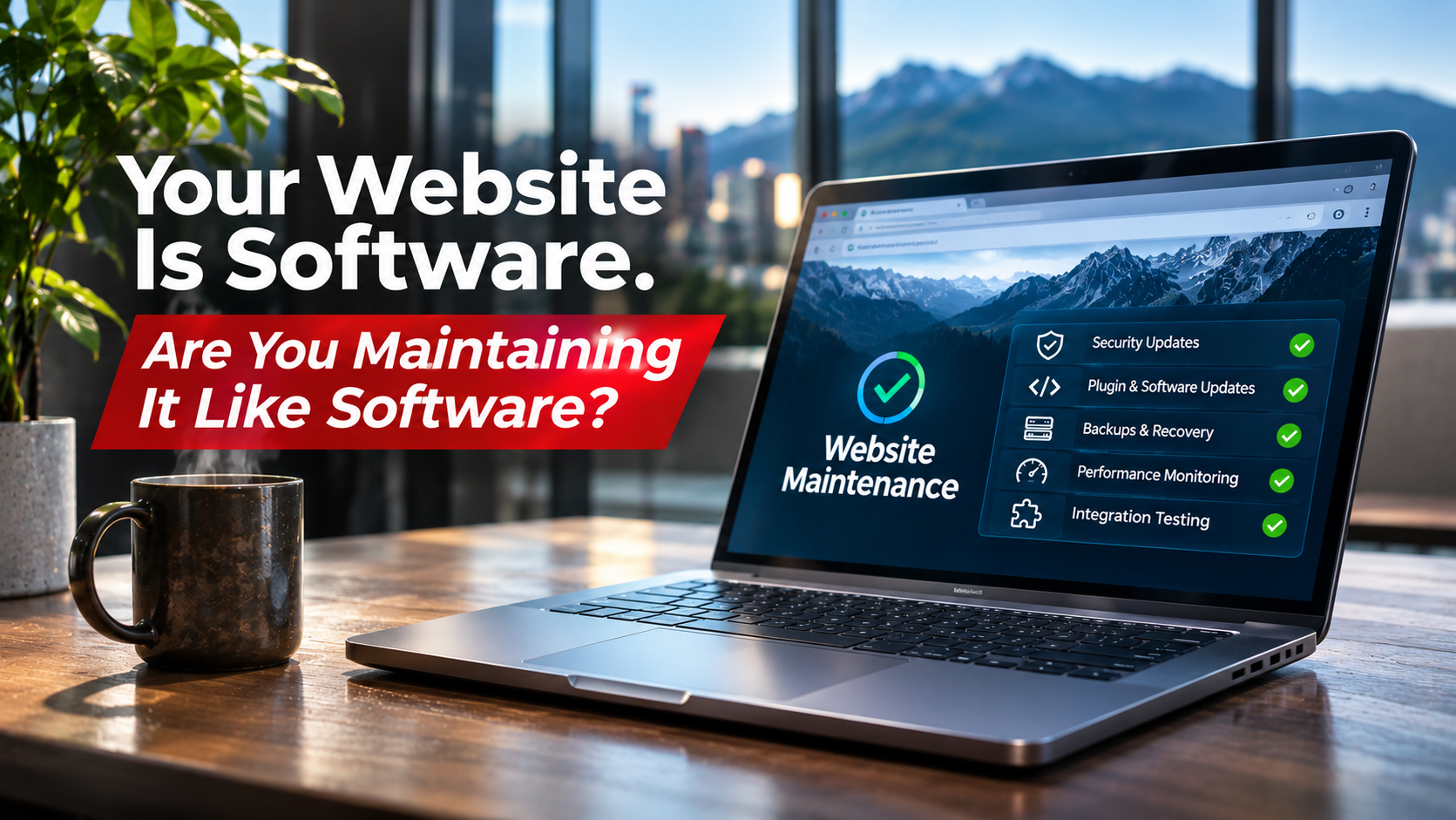
For many businesses, a website is still treated primarily as a marketing asset. Companies invest in design, content, SEO, and advertising, but once the website is launched, ongoing maintenance often becomes an afterthought.
The problem is that modern websites are no longer just static collections of webpages. They are software applications connected to databases, content management systems, payment platforms, CRMs, analytics tools, and third-party services. They depend on frameworks, plugins, server software, and other components that require ongoing updates.
When any of these components become outdated, incompatible, or vulnerable, the consequences can extend beyond a broken webpage to security incidents, lost customer inquiries, and business interruptions.
Recent Security Updates Are a Reminder
October 2026 provided two important examples of why website maintenance matters.
On October 21, the PHP development team released emergency security updates addressing two critical vulnerabilities that could allow attackers to execute malicious code on vulnerable servers without authentication. PHP is widely used by websites and applications, including WordPress, Drupal, and many custom business systems.
A week later, on October 28, WordPress released security updates addressing multiple vulnerabilities and recommended that website owners update immediately.
In both cases, Smartt promptly updated its FlexHours servers and affected client websites. This is also why we maintain a strict policy against running end-of-life (EOL) software on our managed hosting infrastructure. Once software is no longer supported, newly discovered vulnerabilities may never receive security patches, leaving businesses exposed to risks that cannot be properly addressed through routine updates.
These incidents highlight a fundamental issue with modern websites: even if a business has not changed anything on its website, the software it depends on is constantly changing. New vulnerabilities are discovered, software versions reach end of support, and previously secure configurations may become exposed to new risks.
This is why maintaining a website involves much more than keeping its content current.
Website Maintenance Is More Than Installing Updates
Keeping software updated is important, but updates can also introduce compatibility problems. A WordPress plugin update might conflict with a theme, a PHP upgrade could break an older application, or a change to a form integration might prevent customer inquiries from reaching the CRM.
For businesses that depend on their websites for sales and customer service, these are operational problems rather than minor technical inconveniences.
A proper website maintenance process should include several areas:
1. Software and security updates. Core software, plugins, frameworks, and server components should be monitored and updated based on security risks, compatibility, and support requirements.
2. Testing and change management. Significant updates should be tested before deployment, preferably in a staging environment, to identify potential conflicts and avoid disrupting production systems.
3. Backups and recovery. Businesses need reliable backups and a tested recovery process to restore operations when something goes wrong.
4. Security and performance monitoring. Websites should be monitored for vulnerabilities, unusual activity, outages, and performance degradation so that problems can be identified before they cause significant disruption.
5. Integration testing. Forms, payment systems, CRM connections, analytics tracking, and other business-critical workflows should be checked regularly. A website can appear to be functioning normally while silently failing to capture leads or process transactions.
These practices are standard parts of maintaining business software, yet they are frequently overlooked when websites are managed exclusively as marketing projects.
Who Is Actually Responsible for Your Website?
One of the challenges is that website responsibilities often fall between departments and vendors.
The marketing team manages content and campaigns, a web agency handles design and development, the hosting provider manages server infrastructure, and internal IT looks after cybersecurity and business systems.
When something goes wrong, it may not be immediately clear who is responsible.
For example, if a website stops sending leads to a CRM after an update, is that a website problem, an integration problem, or a CRM problem? If an outdated plugin is exploited, who was responsible for monitoring it? If a server upgrade breaks a custom application, who should have tested the change?
As websites become more deeply integrated with business operations, these responsibilities need to be clearly defined rather than divided into isolated services.
At Smartt, our experience across web development, hosting, managed IT, cybersecurity, and digital marketing allows us to approach website management as part of a broader technology environment. Maintaining a website is not simply about keeping it online, but also ensuring that its security, performance, integrations, and business functions continue to operate reliably.
Our FlexHours program brings these capabilities together, allowing businesses to access different areas of technical expertise through a single service arrangement, with hosting included in eligible packages.
If you want to maintain your website as a business-critical application rather than just a marketing asset, talk to Smartt about our FlexHours program.


