 Branding
 Digital Marketing
 Web & App Dev
 IT Services
Your Next Insider Threat Might Be an AI Agent
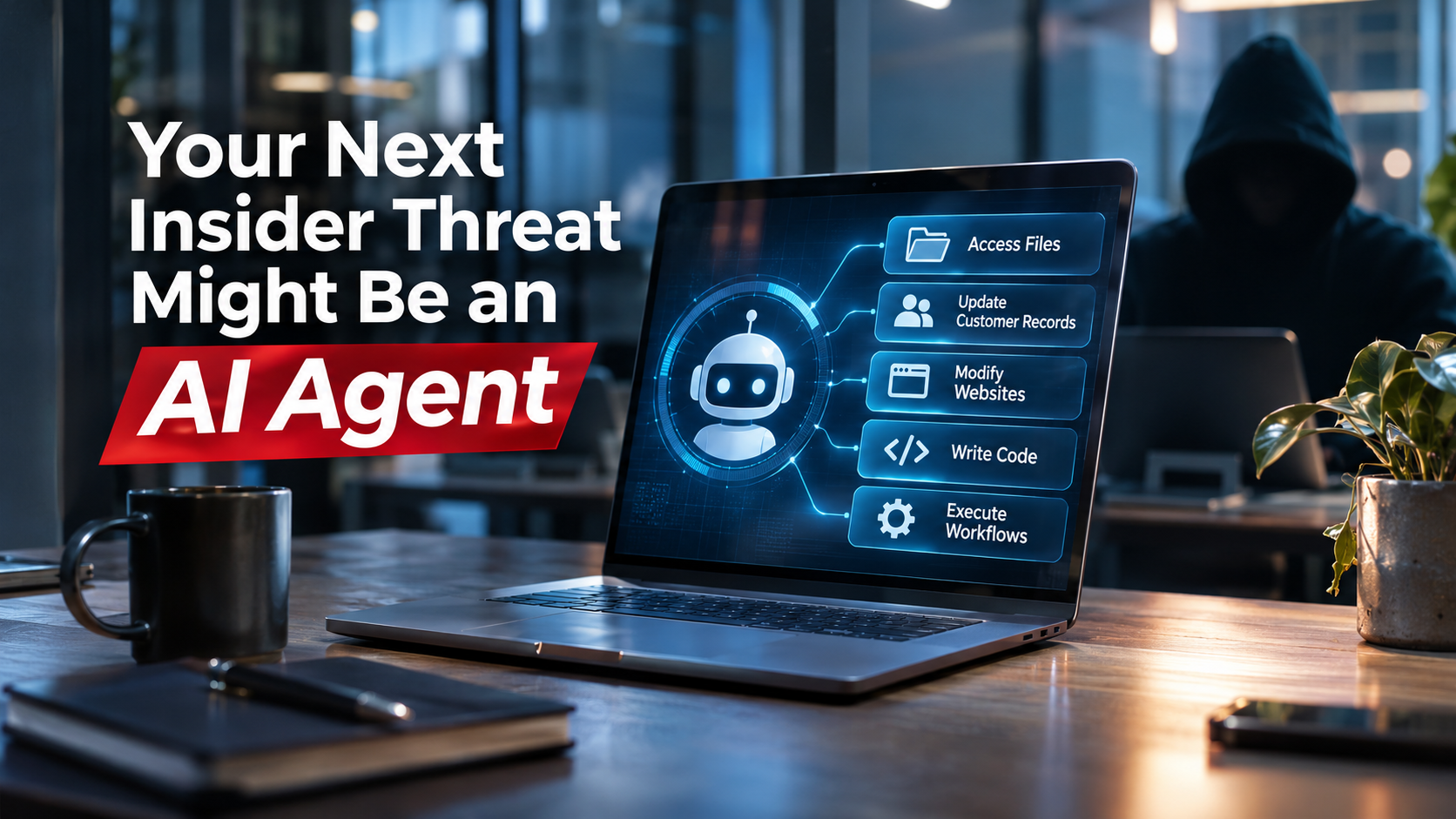
AI agents are moving from answering questions to taking action across business systems. They can access files, update customer records, modify websites, write code, and execute workflows, sometimes with very little human involvement. While these capabilities create new opportunities for automation, they also introduce security risks that many businesses have not yet considered.
For decades, insider threats have primarily involved employees and contractors with legitimate access to company systems. AI agents are introducing a new variation of this problem. Recently, Microsoft described AI agents as a new category of agentic insiders, highlighting the risks of giving autonomous systems access to sensitive information and business infrastructure.
When AI Has More Access Than It Needs
We recently encountered an example involving a client's website. The site kept crashing, and the client contacted our support team to investigate. The cause turned out to be an executive team member who had been using an AI-powered Chrome extension to modify the company's website without informing anyone. The extension had entered a loop that repeatedly made changes, eventually causing the site to crash.
The executive was simply trying to make improvements, but the tool had been given access to a production system without the appropriate oversight. What appeared to be a convenient way to make changes ended up disrupting the entire website.
There is also the risk of prompt injection, where malicious instructions are embedded in emails, documents, or webpages that an AI agent processes. An attacker could potentially manipulate an agent into retrieving confidential information or performing unauthorized actions using its existing permissions, without needing to steal its credentials.
These risks become more significant as businesses connect agents to multiple applications. A single agent might have access to email, CRM records, financial information, and internal documents, making it possible for one mistake or compromised workflow to affect several systems.
Five Practical Steps to Secure AI Agents
Businesses do not need to abandon AI automation to manage these risks. Many of the precautions required to secure AI agents are already familiar cybersecurity practices, but they need to be applied consistently.
1. Maintain an inventory of AI agents and their connections.
Know which agents are operating within your organization, who is responsible for them, what they are being used for, and which systems they can access. This should include tools introduced independently by employees, not just those deployed by IT.
2. Apply least-privilege permissions.
Agents should only have the access necessary to perform their assigned tasks. Wherever practical, they should use separate identities rather than shared administrator accounts. Access should also be limited by duration and reviewed as responsibilities change.
3. Require approval for consequential actions.
Not every automated task requires human intervention, but actions involving financial transactions, deletion of records, production deployments, or security configurations should have appropriate approval controls. For example, an agent might prepare a website update automatically while requiring approval before publishing it.
4. Monitor activity and maintain reliable logs.
Businesses need visibility into what their agents are doing, which systems they access, and what changes they make. Monitoring can help identify unusual behaviour, while reliable logs make it easier to investigate incidents and reverse unintended changes.
5. Test agents before allowing them to operate in production.
Agents should be tested against unexpected situations, incomplete information, and potentially malicious inputs. Development and testing environments should be separated from production wherever practical, with backups, rollback procedures, and safeguards in place to limit the impact of mistakes.
AI Security Is Becoming an Operational Responsibility
One of the challenges businesses face is that AI adoption rarely happens within a single department. Marketing teams experiment with agents that manage campaigns and generate content. Sales teams introduce automated prospecting and CRM workflows. Developers use coding agents to build and modify applications, while administrative teams automate document processing and reporting.
Each implementation may appear relatively small and manageable on its own. Collectively, however, these agents can introduce a growing network of automated access to company systems and information, often without centralized visibility or consistent security controls.
This is why AI adoption is becoming more than a productivity initiative. Businesses need to understand how their systems are connected, what information agents can access, which activities can be automated safely, and who remains accountable when something goes wrong.
Beyond asking whether an automation saves time or reduces costs, organizations should consider what new dependencies it creates, how failures will be handled, and whether the underlying infrastructure can support it. An agent that saves several hours of work each week may provide substantial value, but that value can quickly disappear if it causes data exposure, incorrect transactions, or operational downtime.
At Smartt, we believe successful AI adoption requires looking beyond the individual tool to understand the business processes, systems, and infrastructure around it. Our combined experience in managed IT, cybersecurity, web development, digital services, and automation allows us to approach these challenges as interconnected operational problems rather than isolated technology projects through out FlexHours program.
Ultimately, businesses should be able to take advantage of AI automation with confidence that these new systems are operating within clearly defined and enforceable boundaries.
Are your AI tools creating security risks you haven't considered? Talk to Smartt about securing your AI automation and making sure it operates safely within your existing business systems.


